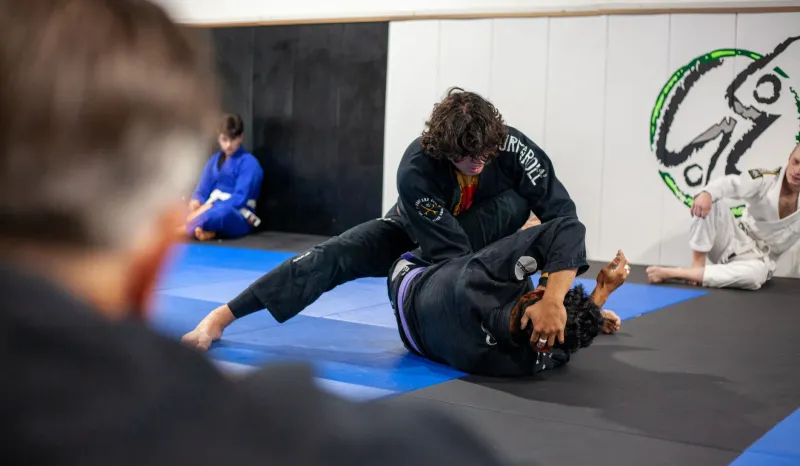
Living-Room Shrimps: Five-Minute Solo Drills for Bury Grapplers With No Mat and No Room
Photo: Murrycko, CC BY-SA 4.0, via Wikimedia Commons
Most Bury grapplers do not have a spare room kitted out like a fight gym. You might have a patch of carpet between the sofa and the telly, a kitchen floor that is clean for roughly eleven minutes a day, or a hallway that is just about long enough for a hip escape if nobody needs the loo. That is fine. Solo jiu-jitsu at home is not about recreating the academy. It is about keeping the movement patterns warm when life gets tight.
Between a shift, the school pick-up, tea, and the actual training you do manage to get to, a five-minute movement snack can be surprisingly useful. Not a substitute for mat time. Not a shortcut to a stripe. Just a small, repeatable way to remind your hips, shoulders and brain what grappling feels like when you cannot get to the club.
Why short and boring beats heroic and rare
A lot of home training plans fail because they are too ambitious. Someone decides they will do forty minutes of solo drills every morning, manages it once, then feels guilty every time they walk past the yoga mat they bought in a burst of enthusiasm. Bury life is not built around forty-minute windows. It is built around ten minutes here, fifteen there, and a cup of tea going cold on the side.
So aim small. Five to ten minutes is enough to count. The goal is consistency and control, not sweat-soaked drama. A few controlled hip escapes while the kettle boils will do more for you over a month than one frantic session that leaves you unable to use the stairs.
The five-minute movement snack menu
Pick two or three of these, not all of them. Use a phone timer, work for thirty to forty seconds, rest for twenty, and keep the effort smooth. You are practising movement, not trying to win a fictional round.
Slow hip escapes. Lie on your back, feet flat, and shrimp one side at a time. Keep it deliberate. Think about pushing with your feet and lifting your hips rather than dragging yourself along by your neck. If you have a hard floor, put a towel or rug down first and clear the area around you.
Glute bridges. Feet flat, knees bent, drive through your heels and lift your hips. Pause at the top. This is a simple way to wake up your hips and lower back without needing space or equipment.
Butterfly hook lifts. Sit with your feet together and knees out, then gently lift one foot at a time while keeping the movement controlled. It is a small drill, but it helps you feel the hook position you will use from guard.
Sit-throughs. From a seated position, plant one hand, lift your hips and thread your leg through. Keep the range small if your floor is slippery or your space is tight. Smooth beats fast.
Technical stand-up — scaled down. If you have room, practise standing up from seated without putting your hands behind you in a way that would get you swept. If you do not have room, just rehearse the hand placement and the first part of the movement slowly. A cramped hallway is not the place for a full-speed technical stand-up into the coat rack.
Neck-safe rocking. Lie on your back, tuck your chin gently and rock your knees side to side. Do not crank your neck. Do not bridge onto your head. This is about gentle spinal movement, not proving anything to your vertebrae.
Safe at home means honest about your space
Before you start, move the coffee table. Check for Lego, phone chargers, a dog that has decided this is now a group activity, and any hard edge at exactly head height. A kitchen floor is fine for slow hip work, but it is not the place for explosive sprawling. Save that for the mats.
Avoid anything that loads your neck or spine in a risky way. Solo drilling should not include full-on submission cranks, hard sprawls onto a wooden floor, or anything that makes you hold your breath and hope. If a movement feels sharp, pinchy or wrong, stop. You are not being soft. You are being sensible.
Also remember that carpet, laminate and tiles all behave differently. Socks on a smooth floor can be slippery. Bare feet on carpet can drag. Adjust the range and speed to the surface. A slow, controlled rep is always better than a fast one that sends you into the radiator.
How not to groove bad habits
This is the honest risk of home drilling. Without a coach watching, you can repeat a sloppy movement until it feels normal. The fix is not to avoid solo drills. The fix is to keep them simple and check yourself.
Use a mirror if you have one. Film twenty seconds on your phone and watch it back once. Are you shrimping by twisting your neck? Are your hips actually moving, or are you just wriggling? Are you rushing the start and then collapsing at the end? You do not need a film crew. You just need one honest look.
Keep the drills basic. A slow hip escape done well is useful. A complicated sequence you half-remember from a video is not. If you are unsure whether you are doing something correctly, do the simpler version and ask about it at your next session.
Bring the questions back to the Bury mats
Home drilling works best when it feeds back into your club training. After a few sessions of movement snacks, you will probably notice something. Maybe your hip escapes feel smoother on one side. Maybe your butterfly hooks feel stronger. Maybe you have realised you do not really understand what your coach means by "keep your frames".
Take those questions to your Bury coach. Ask before or after class, or during a quiet drill break. Keep it specific: "I have been practising slow hip escapes at home and my left side feels different — am I shifting my weight wrong?" That is a much better question than a vague worry. Coaches can correct a small thing in thirty seconds if they can see it.
Do not treat home drills as a secret curriculum. Treat them as homework that supports what you are already being taught. If your club is working on guard retention, spend a few minutes on hip movement. If you have been drilling sit-throughs, rehearse the shape at home. Keep it connected.
A realistic Bury week
You do not need a perfect plan. Try this: two five-minute sessions between now and your next class. One after the school run, one while the oven heats up. Pick two drills from the menu. Keep them slow. Ask one question at the club. That is it.
If you miss a day, nothing collapses. If you manage four sessions in a week, brilliant. The point is to stay in touch with the movement, not to add another guilt-laden to-do list to your kitchen calendar. Bury grapplers are busy people. Small, regular, controlled practice is how you keep jiu-jitsu ticking over when the mat is not quite within reach.
So clear a bit of floor, set a timer for five minutes, and start with the simplest thing you know. Your next Bury session will thank you for it.