The Quiet Skill: Why Tapping Early Is a Bury Beginner’s Best Friend
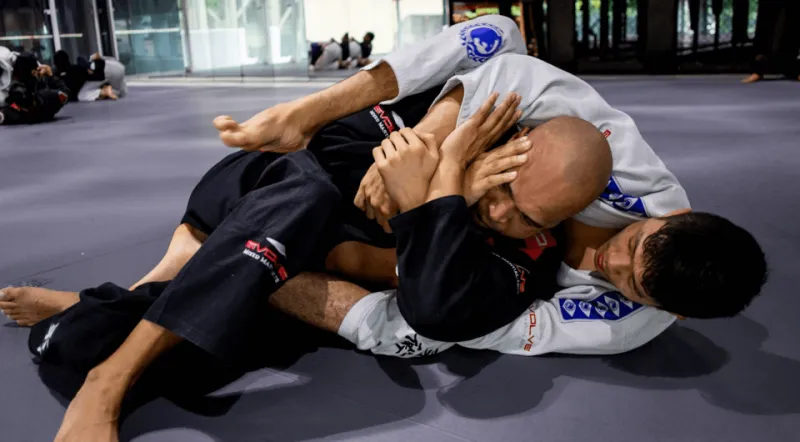
Photo: Brazilian Jiu-jitsu news, CC BY-SA 4.0, via Wikimedia Commons
If you’re new to Brazilian jiu-jitsu around Bury, there’s a decent chance you’ll hear the word “tap” before you hear “guard pass” or “triangle”. It comes up in the first class, in the safety brief, and in that slightly awkward moment when someone has your arm in a place it wasn’t designed to go. Tapping can feel like admitting defeat. In reality, it’s one of the most useful skills you’ll learn in your first few months on the mats.
This isn’t about being soft or avoiding pressure. It’s about staying in the game long enough to actually learn it. Whether you train in Bury town centre, over towards Radcliffe or Whitefield, or out in Ramsbottom or Tottington, the same principle applies: a good tap keeps you training, keeps your partner honest, and keeps the club culture healthy.
Tapping Is Information, Not Surrender
In jiu-jitsu, a tap is a signal. It says “you’ve got me here” or “that’s my limit today”. It’s no more dramatic than calling “mine” when you’re carrying a sofa. The mat is a working environment, and tapping is part of the language.
Beginners sometimes wait too long because they think tapping means they failed the round. But sparring isn’t a test with a pass mark. It’s a conversation with movement. If your partner catches a submission cleanly, they’ve already done the thing they were trying to do. Holding on for another five seconds doesn’t prove toughness; it mostly proves you’re willing to risk a sore elbow or a tweaked knee for the sake of pride.
Early tapping also gives you better information. If you tap as soon as you feel the grip tighten or the angle lock in, you start learning to recognise danger earlier. That’s a skill. Experienced grapplers often tap quickly in training because they know exactly when a position has gone past the point of escape. Beginners can borrow that habit straight away.
The Ego Bit (Yes, Everyone Has One)
Let’s be honest: nobody walks into their first Bury BJJ class hoping to tap to a white belt two stone lighter than them. Ego is part of the sport. The trick is not pretending it isn’t there. The trick is giving it a sensible job.
Your ego can push you to turn up on a wet Tuesday when the Metrolink is delayed and the sofa is calling. It can help you drill that sweep one more time. It should not be in charge of whether you tap to an armbar. That’s a bit like letting your ego decide whether to wear a seatbelt.
One useful reframe for beginners is to treat every early tap as a deposit in your training account. You’re protecting your joints, your sleep, and your ability to come back next week. Nobody remembers who tapped in the Tuesday fundamentals class. People do remember the training partner who was off the mats for six weeks with a dodgy shoulder.
Injury Prevention Is a Community Job
In a local club, injuries don’t just affect one person. They ripple out. The training partner feels bad. The coach has to adjust the session. The person who was going to drill with you on Thursday needs a new partner. Bury’s jiu-jitsu scene is friendly and growing, and that friendliness depends on people looking after each other.
Early tapping is a big part of that. It lets your partner know where the line is without anyone having to guess. It also protects you from the classic beginner injury: the slow, stubborn submission that doesn’t hurt much at the time but leaves you wincing in the shower the next morning.
If you’re rolling with someone newer than you, say clearly: “Tap early, I won’t be offended.” If you’re the newer grappler, believe them. A good training partner would rather feel you tap than feel you limp.
Mat Etiquette: Make the Tap Clear
A tap should be unmistakable. Use your hand to tap the mat or your partner, or tap with your foot if your hands are trapped. If you can’t move your hands or feet, say “tap” loudly. There’s no prize for a subtle tap that nobody notices.
It’s also fine to tap before a submission is fully locked in. If you’re caught in a tight triangle and you know you’re not getting out, tap. If your partner has a kimura grip and you’re not sure which way to turn, tap. You can always ask about the escape afterwards. In fact, that’s one of the best things about a good Bury club: you can tap, reset, and then say “what should I have done there?”
What Early Tapping Looks Like in Practice
Early tapping doesn’t mean panicking at every grip. It means knowing the difference between discomfort and danger. Pressure on your ribs from side control is uncomfortable, but it’s usually not going to break anything. A rotated knee or a cranked neck is different. Learn to tell the difference, and when in doubt, tap.
A simple rule for beginners: if you have to think “is this bad?” for more than a second, it’s probably time to tap. You can always start again. You can’t always undo a joint injury.
It also helps to decide before the round that you’re going to tap early. Say it to yourself while you’re tying your belt. That way, when the moment comes, you’re not making a decision under pressure. You’ve already made it.
How Bury Clubs Can Make It Normal
Coaches and senior students set the tone. If a black belt taps quickly in training and says “good catch”, everyone learns that tapping is normal. If a coach stops a drill to say “tap earlier there”, beginners learn that safety is part of technique, not an afterthought.
Local clubs can also make early tapping part of the language in beginners’ classes. A quick reminder before sparring — “clear taps, early taps, look after each other” — does more than a lecture. And when someone taps, a simple “nice one” or “good control” from their partner makes the whole thing feel less like a loss and more like good mat manners.
The Long Game
Bury BJJ Hub is here for the long game: the beginners who become regulars, the regulars who become good training partners, and the good training partners who keep the club welcoming. Tapping early is part of that. It’s not the loudest skill you’ll learn, but it might be the one that keeps you on the mats long enough to enjoy the rest.
So tap first. Ask questions after. Then get back in there, because there’s plenty more to learn — and a brew and a chat after class is always better when everyone’s still in one piece.